Is QQQ Halal? Nasdaq-100, SMH, SOXX and Halal Alternatives
Is QQQ halal? We screen QQQ, QQQM, SMH and SOXX for Shariah compliance and compare halal ETF alternatives for technology and growth investors.

The Invesco QQQ ETF gives investors exposure to some of the world's largest companies, including Apple, NVIDIA, Microsoft and Amazon. But is QQQ halal?
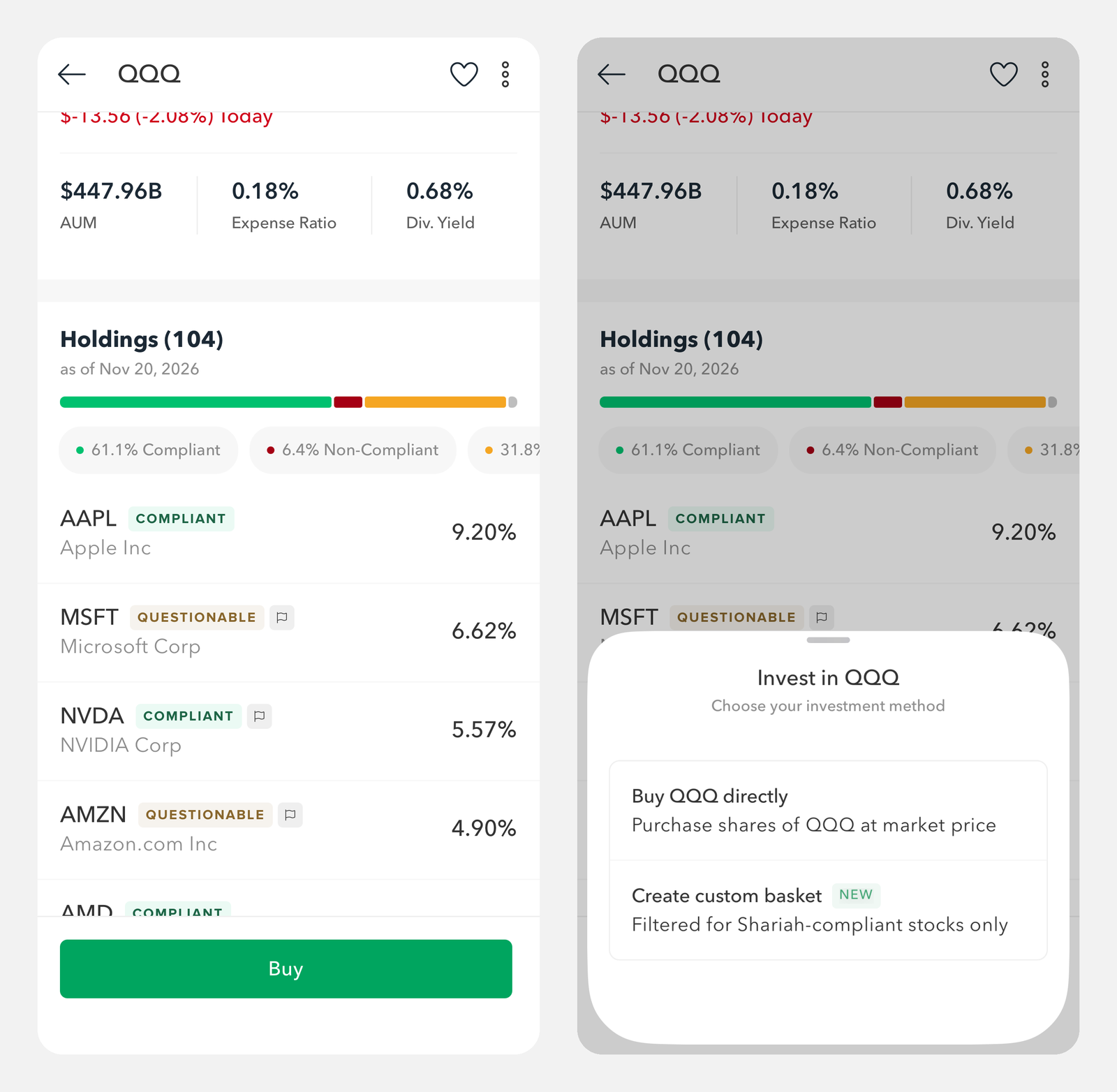
QQQ doesn't pass Shariah screening as a fund, and the same goes for QQQM and the Nasdaq-100 index both funds track. About 62% of QQQ's portfolio is in stocks Zoya rates Compliant, 31% in Questionable stocks and 6% in Non-Compliant stocks.
The results are different for popular semiconductor ETFs. Every stock in SMH passes Zoya's screen, and every rated stock in SOXX passes too. However, neither fund is Shariah-certified.
In this guide, we break down what each fund holds, explain why purification can't make QQQ pass and compare halal alternatives for technology and growth investors, from Shariah-certified ETFs to Zoya baskets.
Key takeaways
- Half of QQQ's 10 largest companies are Questionable, and 20 smaller companies are Non-Compliant.
- Purification removes impermissible income from investments that pass screening. It can't make QQQ's Non-Compliant holdings permissible.
- Every SMH stock passes Zoya's screen, and Zoya marks the fund Compliant. SOXX has 99.1% of its weight in Compliant stocks and one unrated holding. Neither fund has a Shariah board.
- Zoya Pro's Nasdaq 20 basket holds the 20 largest Compliant stocks in QQQ. HLAL and SPUS are the closest Shariah-certified ETFs we compared.
Table of contents
- Is QQQ halal?
- Which QQQ stocks pass Shariah screening?
- Can you hold QQQ and purify it?
- Halal alternatives to QQQ
- Is SMH halal?
- Is SOXX halal?
- Is there a halal semiconductor ETF?
- Choosing a halal alternative to QQQ
- Frequently asked questions
Is QQQ halal?
Here is how $10,000 in QQQ breaks down by Zoya status:
| Zoya status | Share of QQQ | Of $10,000 in QQQ | Largest holdings |
|---|---|---|---|
| Compliant | 62.3% | $6,228 | Apple, NVIDIA, AMD, Micron, Tesla |
| Questionable | 31.3% | $3,125 | Microsoft, Alphabet, Amazon, Meta, Walmart |
| Non-Compliant | 6.2% | $618 | T-Mobile, Marriott, Comcast, Mondelez, Moderna |
| Cash and index futures | 0.3% | $29 |
How we screened: holdings as of November 16, 2026 for QQQ and November 17 for SMH and SOXX, with Zoya statuses checked November 18. Each company is counted once, with Alphabet's two share classes combined. Cash and index futures are counted as weighted in the holdings data. Percentages are rounded, so totals can differ slightly from 100.
A Questionable rating marks a gray area. Usually part of the company's revenue comes from an activity on which Shariah scholars differ, such as advertising that can carry objectionable content, streaming entertainment or a supermarket that also sells alcohol and pork. Sometimes the company doesn't disclose enough for a clear result. Zoya leaves the decision to you, and each company's Zoya report explains the reason. Even if you accept every Questionable stock, QQQ still holds Non-Compliant companies worth $618 of every $10,000 invested.
Invesco QQQ tracks the Nasdaq-100 Index, 100 of the largest non-financial companies listed on Nasdaq, with no Shariah screen or Shariah board. QQQM tracks the same index and holds the same stocks, so the same conclusion applies to QQQM.
Zoya marks a fund Compliant when every holding passes its screen or when the fund has its own Shariah certification. QQQ meets neither condition, so it is unrated in Zoya. In the Zoya app, QQQ's page lists its holdings and their status, with the full list and percentages on Zoya Pro. In search results, SMH carries a Compliant label, while QQQ and SOXX carry none.
Is the Nasdaq-100 halal?
The Nasdaq-100 is the index QQQ tracks, so the same conclusion applies to the index as a whole. Nasdaq Inc, the company that runs the exchange, is a separate stock with its own Zoya report under NDAQ.
Which QQQ stocks pass Shariah screening?
For this analysis, we screened each fund's underlying stocks in Zoya, using the Shariah screening criteria set by the Accounting and Auditing Organization for Islamic Financial Institutions (AAOIFI). On the business screen, a company's main business must be permissible, and revenue from impermissible sources must not exceed 5% of the total. The financial screen allows interest-bearing debt of up to 30% of market capitalization, and the same for interest-bearing deposits and securities. Zoya measures market capitalization at the end of the company's latest reported financial period, not as a trailing average. Other screening standards set different limits, so they can reach different results for the same company.
Half of QQQ's 10 largest companies pass both screens:
| Company | Share of QQQ | Zoya status |
|---|---|---|
| Apple (AAPL) | 8.7% | Compliant |
| Microsoft (MSFT) | 6.5% | Questionable |
| NVIDIA (NVDA) | 6.4% | Compliant |
| Alphabet (GOOGL) | 5.5% | Questionable |
| Amazon (AMZN) | 4.7% | Questionable |
| AMD (AMD) | 3.8% | Compliant |
| Micron (MU) | 3.8% | Compliant |
| Tesla (TSLA) | 3.4% | Compliant |
| Meta (META) | 3.2% | Questionable |
| Walmart (WMT) | 2.9% | Questionable |
Together, the five Questionable companies make up about 23% of QQQ. All five pass the financial screen, with debt and interest-bearing deposits and securities each under 30% of market capitalization. Their Questionable ratings come from parts of their business, such as advertising at Alphabet and Meta, streaming entertainment at Amazon, and alcohol and pork sales at Walmart.
The 20 Non-Compliant companies account for a smaller share of the fund: QQQ's 28 largest companies are all Compliant or Questionable. Most of the 20 fail the financial screen. The largest, T-Mobile (TMUS) at 0.85% of QQQ, has debt equal to 68% of its market capitalization. Marriott (MAR) fails the business screen, and Comcast (CMCSA) fails both.
Can you hold QQQ and purify it?
Purification can't make QQQ pass Shariah screening.
Purification is meant to remove impermissible income from investments that pass screening. You give to charity the small share of your income that came from impermissible sources, such as interest a company earns on its cash. AAOIFI's Shariah Standard 21 notes that most fatwa bodies and Shariah boards allow you to keep shares that pass the screen and purify that income. Purification doesn't make a Non-Compliant investment permissible.
So the $618 invested in Non-Compliant companies for every $10,000 in QQQ isn't an amount you can give away to make QQQ compliant. It's your exposure to companies that fail the screen, and purification isn't meant to cover it.
Different considerations apply when a stock you already own becomes non-compliant. Zoya's guide to what to do when a stock becomes non-compliant covers selling it right away or holding it for a short grace period, and purifying your income from the time it failed.
Where you have no compliant option, such as a workplace plan that offers only conventional funds, some scholars allow holding the fund with the least non-compliant exposure and giving away that share of its returns, as our guide to whether your 401(k) is halal explains. That's a concession for restricted choices, not a reason to pick QQQ over a compliant alternative you can buy. If you already own QQQ, ask a scholar about your situation. Our stock purification guide explains the methods.
Halal alternatives to QQQ
Investing in the Nasdaq-100 doesn't have to mean owning every company in the index. You can start from QQQ's Compliant stocks with a Zoya basket, or choose a Shariah-certified ETF.
Both approaches will have different weights from QQQ and may perform differently. QQQ isn't a pure technology fund: it also holds retailers, telecoms, food companies and hotels. A 20-stock equal-weight basket gives a smaller company as much weight as Apple or NVIDIA. Managing individual stocks may also require extra trades when you adjust or rebalance, which can have tax consequences in a taxable account. A broader certified ETF holds more stocks with a different sector mix.
Baskets in Zoya
The Nasdaq 20 basket. Zoya Pro's Nasdaq 20 basket holds the 20 largest Compliant stocks in QQQ, equal-weighted, so Questionable names such as Microsoft, Alphabet, Amazon and Meta stay out. Zoya rebuilds the published basket daily so it stays 100% Shariah-compliant, holding only stocks rated Compliant that day. Zoya Pro's Semiconductors basket works the same way with the 10 largest Compliant stocks in SMH.
Shares you've already bought don't change when the published basket does. If a stock you hold changes status, you decide whether to sell it, and Edit holdings in the basket's menu lets you change the basket.
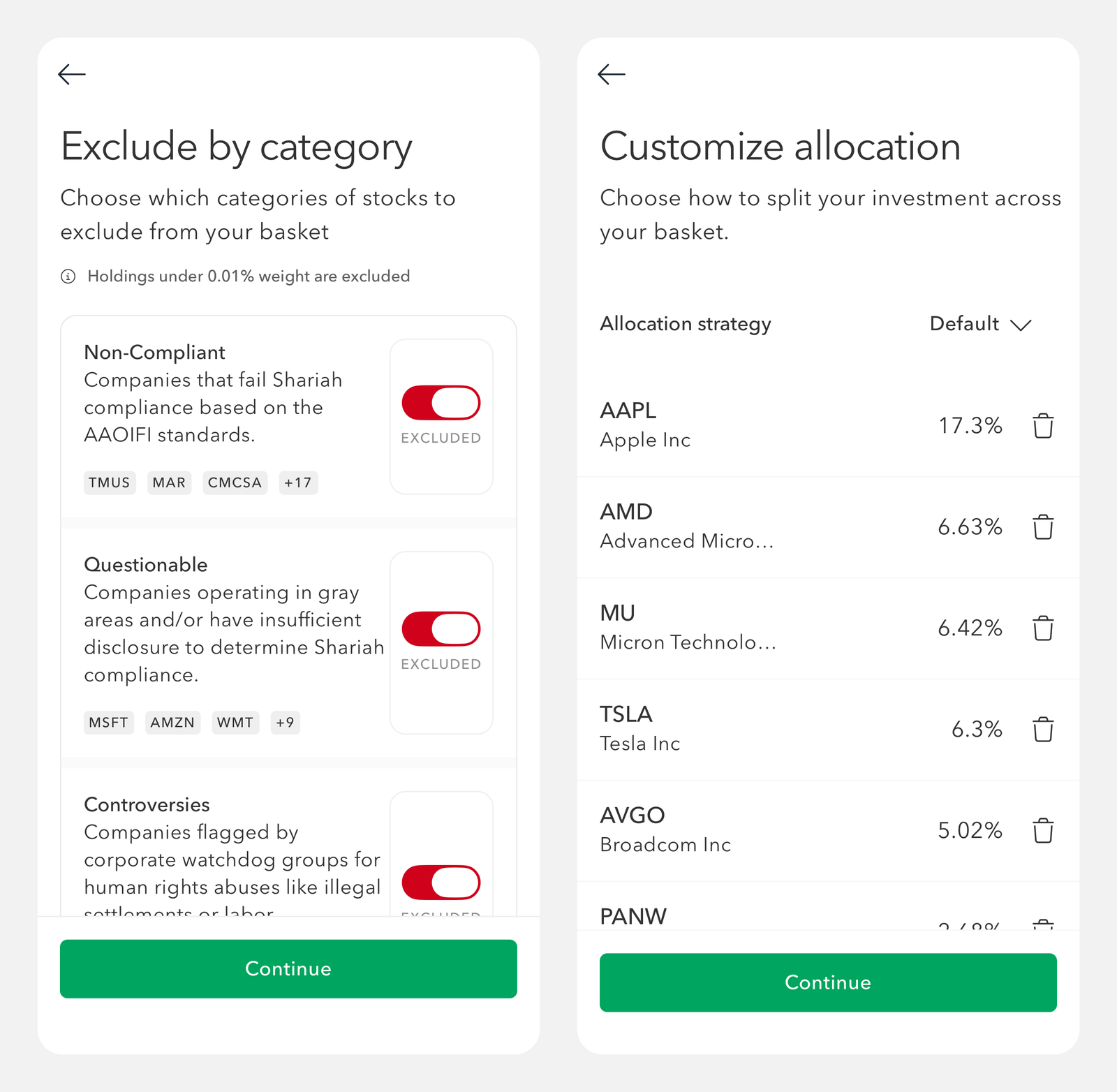
A custom basket from QQQ. With Zoya Pro and a linked brokerage that supports trading in Zoya, open QQQ, QQQM or the Nasdaq-100 Index, tap Buy and choose Create custom basket. Zoya removes Non-Compliant, Questionable and controversial holdings by default and leaves out unrated ones, and you can drop any other stock. By default, the basket keeps QQQ's own weights for the stocks that remain, scaled up to 100%, and you can switch to equal weights or set your own. When we checked in the app on November 24, 2026, the stocks left after the default exclusions made up about 53% of QQQ by weight, so a basket on the default settings had about 53% weighted overlap with QQQ, close to HLAL's. Your basket stays as you built it when the index changes.
Stock statuses change as companies report results, usually each quarter for US companies, so check your holdings in Zoya regularly. Our introduction to stock baskets explains how baskets work.
Shariah-certified ETFs similar to QQQ
Shariah-certified ETFs may follow different screening criteria and scholarly interpretations, overseen by their own Shariah boards. As a result, some hold companies Zoya rates Questionable under the criteria used here, such as Microsoft, as our guide to why Shariah compliance results can differ explains.
To find the closest alternatives, we compared not just which companies each certified ETF holds but how much of the fund it puts in each one. A weighted overlap of 100% would mean two funds hold the same companies at the same weights. Weighted overlap measures how similar two portfolios are, not past performance or future returns.
| Ticker | Issuer | Expense ratio | Shariah screen | Weighted overlap with QQQ |
|---|---|---|---|---|
| HLAL | Wahed | 0.50% | FTSE Shariah USA Index; screened by Yasaar, approved by Wahed's Shariah board | 53.0% |
| SPUS | SP Funds | 0.45% | S&P 500 Shariah Industry Exclusions Index; screened by Ratings Intelligence with a five-scholar board | 50.9% |
| SPTE | SP Funds | 0.55% | S&P Global 1200 Shariah Information Technology (Sector) Capped Index; same screener, annual audits by Raqaba | 40.1% |
Weighted overlap adds up the smaller of the two funds' weights for each company both hold, using mid-November 2026 holdings. We also compared MNZL (38.2%) and AMGR (36.5%), which overlap less with QQQ.
HLAL and SPUS both put about a third of the fund in Apple, Microsoft and NVIDIA, against about 21.6% in QQQ, and SPUS leaves out Amazon and Meta. Our SPUS vs HLAL comparison goes deeper.
SPTE is a global technology fund whose largest holdings include TSMC, ASML and MediaTek alongside Apple, Microsoft and NVIDIA. The best halal ETFs list covers the wider range.
Is SMH halal?
All 25 stocks in SMH, the VanEck Semiconductor ETF, pass Zoya's Shariah screen as of November 17, 2026, so Zoya marks the fund Compliant. But SMH is a conventional ETF, not a Shariah-certified fund. Zoya's Compliant label reflects the stocks SMH holds. It doesn't cover what the fund itself does, such as lending securities and managing cash, and SMH has no Shariah board to oversee either.
Securities lending raises Shariah concerns because a fund that lends its shares earns fees from the borrower and may earn interest by investing the cash collateral it receives. SMH engages in securities lending, as its prospectus permits: its SEC holdings report for September 30, 2026 shows shares worth about 0.6% of the fund on loan that day. That 0.6% is the value of the shares on loan at one point in time, not the share of the fund's income that came from lending.
SMH's index applies no Shariah screen, so a stock that stops passing can stay in SMH for as long as it stays in the index.
SMH tracks 25 large US-listed chip companies, led by NVIDIA (NVDA) at 17.4% and TSMC (TSM) at about 10%, then Broadcom (AVGO). Zoya puts its purification ratio at 1.13%, the share of the dividends you receive from SMH to give to charity. That figure comes from the impermissible revenue of the companies SMH holds and doesn't include any income the fund earns from lending securities or holding cash. Our stock purification guide explains the method.
If you want chip exposure without these fund-level questions, you can hold Compliant semiconductor stocks directly, or use Zoya Pro's Semiconductors basket, which holds the 10 largest Compliant stocks in SMH.
Is SOXX halal?
All of SOXX's rated stock holdings pass Zoya's screen. As of November 17, 2026, 29 of its 30 holdings pass, making up 99.1% of the fund's weight. The remaining holding, Tower Semiconductor (TSEM), was 0.9% of the fund and had no Zoya rating when checked on November 18. An unrated holding means no compliance rating was available, which is different from a holding that fails.
So SOXX and QQQ both lack a Compliant label, for different reasons. QQQ holds Non-Compliant companies. SOXX holds one with no rating, and without its own Shariah certification, every holding must pass for SOXX to get the label.
SOXX tracks the NYSE Semiconductor Index, and its largest holdings are AMD (AMD), Broadcom (AVGO) and Micron (MU). Like SMH, it has no Shariah board, and its prospectus permits securities lending.
Is there a halal semiconductor ETF?
All of SMH's semiconductor stocks pass Zoya's screen, though the fund isn't Shariah-certified. Of the certified funds compared above, SPTE is closest: the SP Funds S&P Global Technology ETF, a technology fund rather than a pure chip fund. The fund invests in 106 technology companies, so its weighted overlap is 39.0% with SMH and 27.5% with SOXX.
SMH and SOXX are concentrated semiconductor funds, not replacements for QQQ's broader mix. For single chip stocks, see our guide to halal AI stocks.
Choosing a halal alternative to QQQ
QQQ, QQQM and the Nasdaq-100 don't pass Shariah screening, and purification can't change that. Which alternative fits depends on what you want from QQQ.
If you want a Shariah-certified fund with a Shariah board and broad exposure to large US growth companies, HLAL and SPUS have the highest weighted overlap with QQQ among the funds we compared. SPTE is more focused on global technology.
If you'd rather choose the companies yourself, Zoya Pro's Nasdaq 20 basket and custom baskets let you build from the Compliant stocks in the Nasdaq-100. For chip exposure, every SMH stock passes Zoya's screen and SOXX's rated holdings pass too, but neither fund is Shariah-certified.
Frequently asked questions
Answers reflect Zoya's results for fund holdings as of November 16 and 17, 2026.
Is QQQ haram to invest in?
QQQ doesn't pass Shariah screening as a fund. Of every $10,000 in QQQ, $618 sits in Non-Compliant companies, and Zoya leaves the fund unrated. For a ruling on your own holding, ask a scholar. Shariah-certified funds such as HLAL and SPUS each have about 50% weighted overlap with QQQ.
Is QQQM halal?
QQQM tracks the same Nasdaq-100 Index as QQQ and holds the same stocks, so the same conclusion applies, and Zoya leaves QQQM unrated too.
Is trading the Nasdaq-100 halal?
Owning the Nasdaq-100 through QQQ or another conventional index ETF raises the same Shariah concerns as QQQ. Many of its stocks pass on their own, such as Apple and NVIDIA, and you can hold those directly. Futures and options on the index raise separate questions, and our guide to day trading covers short-term trading.
Can I keep QQQ and purify the non-compliant part?
Purification removes impermissible income from investments that pass screening. It doesn't make Non-Compliant holdings permissible, so giving money away doesn't make QQQ pass. Where you have no compliant option, such as a workplace plan with only conventional funds, some scholars allow holding the least-exposed fund and giving away the non-compliant share of its returns, as a concession rather than a free choice. If you already own QQQ, ask a scholar about your situation. For a single stock you hold that stops passing, see Zoya's guide to what to do when a stock becomes non-compliant. Our stock purification guide explains the methods.
Is SMH Shariah-compliant?
Every stock in SMH passes Zoya's screen, and Zoya marks the fund Compliant. SMH is still a conventional ETF, not a Shariah-certified fund: the label reflects its stocks, not how the fund manages cash or lends securities, and SMH has no Shariah board. Its holdings change when its index rebalances and company statuses change as companies report, so check it in Zoya regularly.
Is SOXX Shariah-compliant?
Of SOXX's 30 holdings, 29 pass Zoya's screen, making up 99.1% of the fund. The other, Tower Semiconductor, has no Zoya rating, so Zoya doesn't mark SOXX Compliant. Like SMH, SOXX has no Shariah board, and its prospectus permits securities lending.
Is there a halal tech ETF?
SPTE, the SP Funds S&P Global Technology ETF, is a Shariah-certified fund built from technology stocks. HLAL and SPUS are broader Shariah-certified funds with large technology weights. Our list of the best halal ETFs covers them in more detail.
Is there a halal Nasdaq ETF?
We couldn't find a Shariah-certified ETF that tracks the Nasdaq-100. Of the Shariah-certified funds compared here, HLAL and SPUS come closest to QQQ, each with about 50% weighted overlap. You can also start from QQQ's Compliant stocks with a Zoya basket, as described in Baskets in Zoya.