How Abdul El-Sayed Invests: Inside the First Muslim Senator-Elect's Portfolio
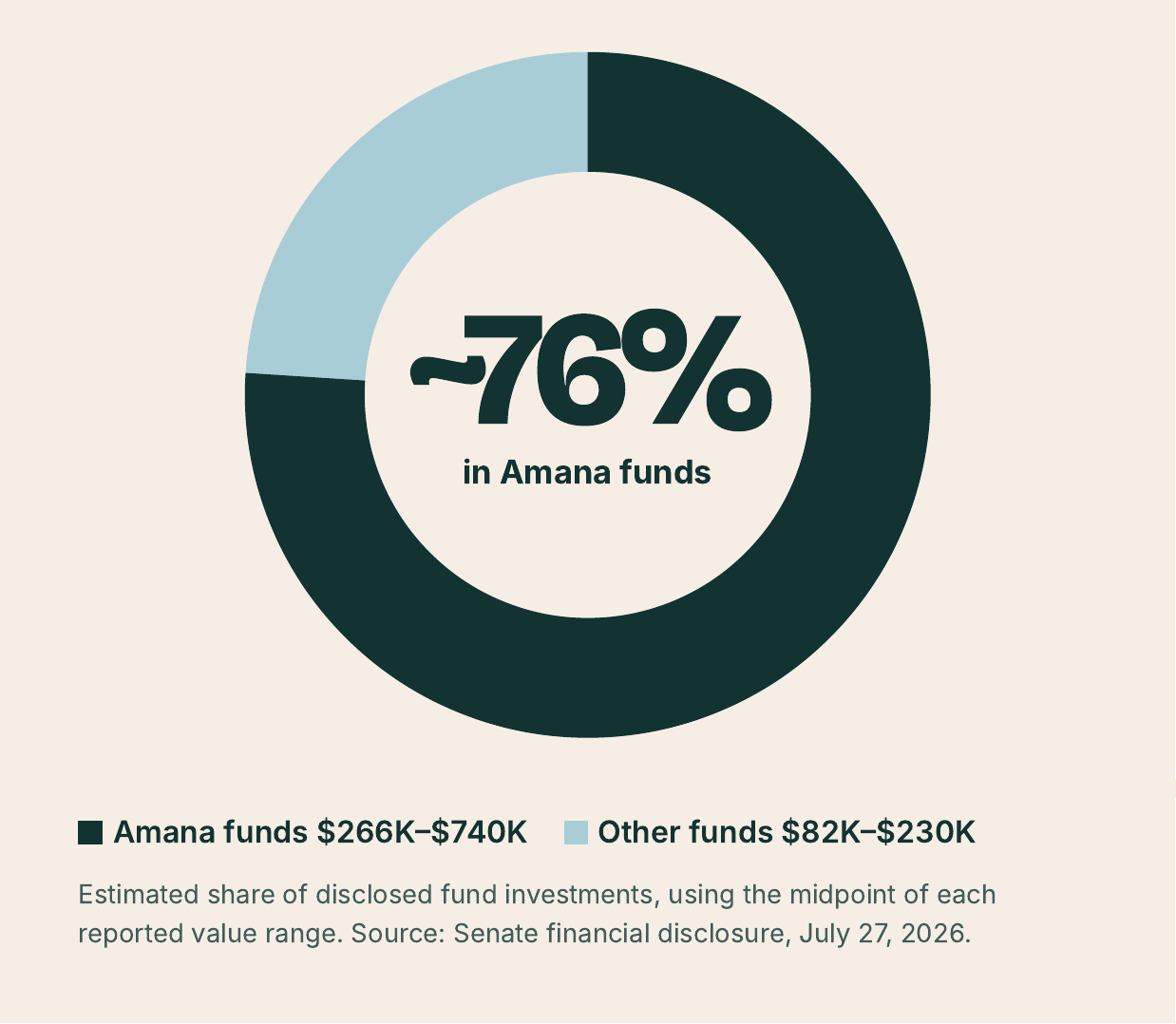
Based on the midpoints of the reported ranges, about 76% of Abdul El-Sayed's disclosed fund investments are in Amana's Shariah-certified funds. See what those funds invest in and how the family's accounts are split.

Abdul El-Sayed, Michigan's senator-elect, is the first Muslim elected to the US Senate, and his financial disclosure gives a rare look at how his family invests. Based on the midpoints of the reported ranges, about 76% of the family's disclosed fund investments are in Amana, one of the oldest halal mutual fund families in the US.
Amana's first fund launched in 1986 as one of the first halal investment options for US investors. The couple's three IRAs hold only Shariah-certified Amana funds, while a child's 529 plans and his wife's 401(a) also hold conventional funds. We went through his report on the Senate's financial disclosure site to see which funds the family holds, what those funds invest in, and how the money is spread across accounts.
Key takeaways
- Amana funds hold $266,000 to $740,000, about 76% of the family's disclosed fund investments at range midpoints. Amana Growth is the biggest position.
- Through Amana's two stock funds, the family has estimated exposure to 51 companies, led by TSMC, Apple, Microsoft and Nvidia.
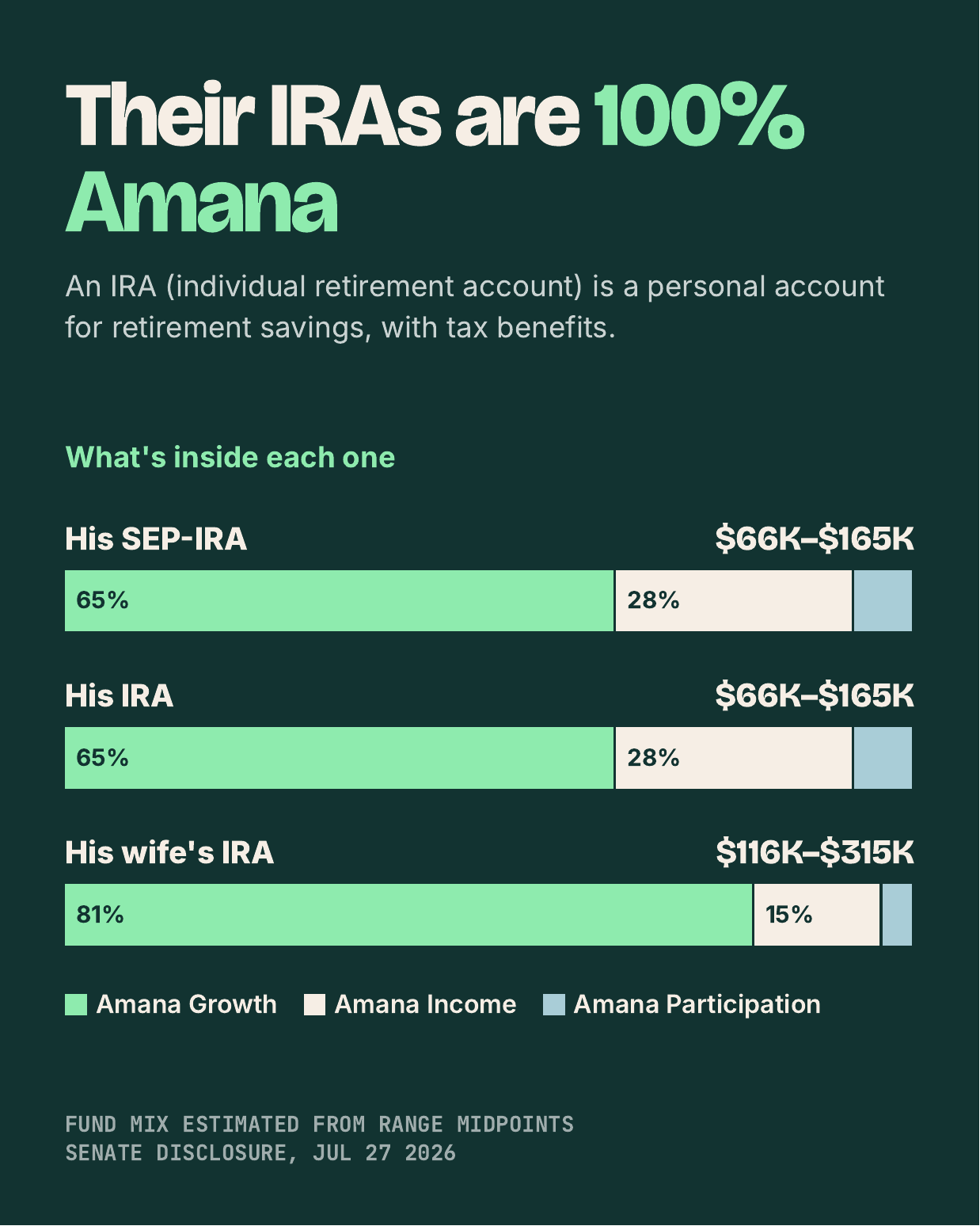
- His SEP-IRA, his IRA and his wife's IRA are 100% Amana, worth $248,000 to $645,000 combined.
- Hypothetically, at 6% a year with no new money, the IRAs' midpoint value would grow to about $1.7 million by 2049.
Table of contents
- What Abdul El-Sayed invests in
- What the Amana Growth, Income and Participation funds hold
- Which companies the El-Sayeds' Amana funds invest in
- How the El-Sayed IRAs are invested
- What the IRAs could be worth at 65
- Abdul El-Sayed's real estate, businesses and debts
- What stands out in the El-Sayed portfolio
- How to check your own portfolio for Shariah compliance
- Frequently asked questions
What Abdul El-Sayed invests in
The Associated Press called Michigan's Senate race for El-Sayed on November 4, 2026. Candidates report each asset as a value range, so every figure here is a range or a midpoint estimate.
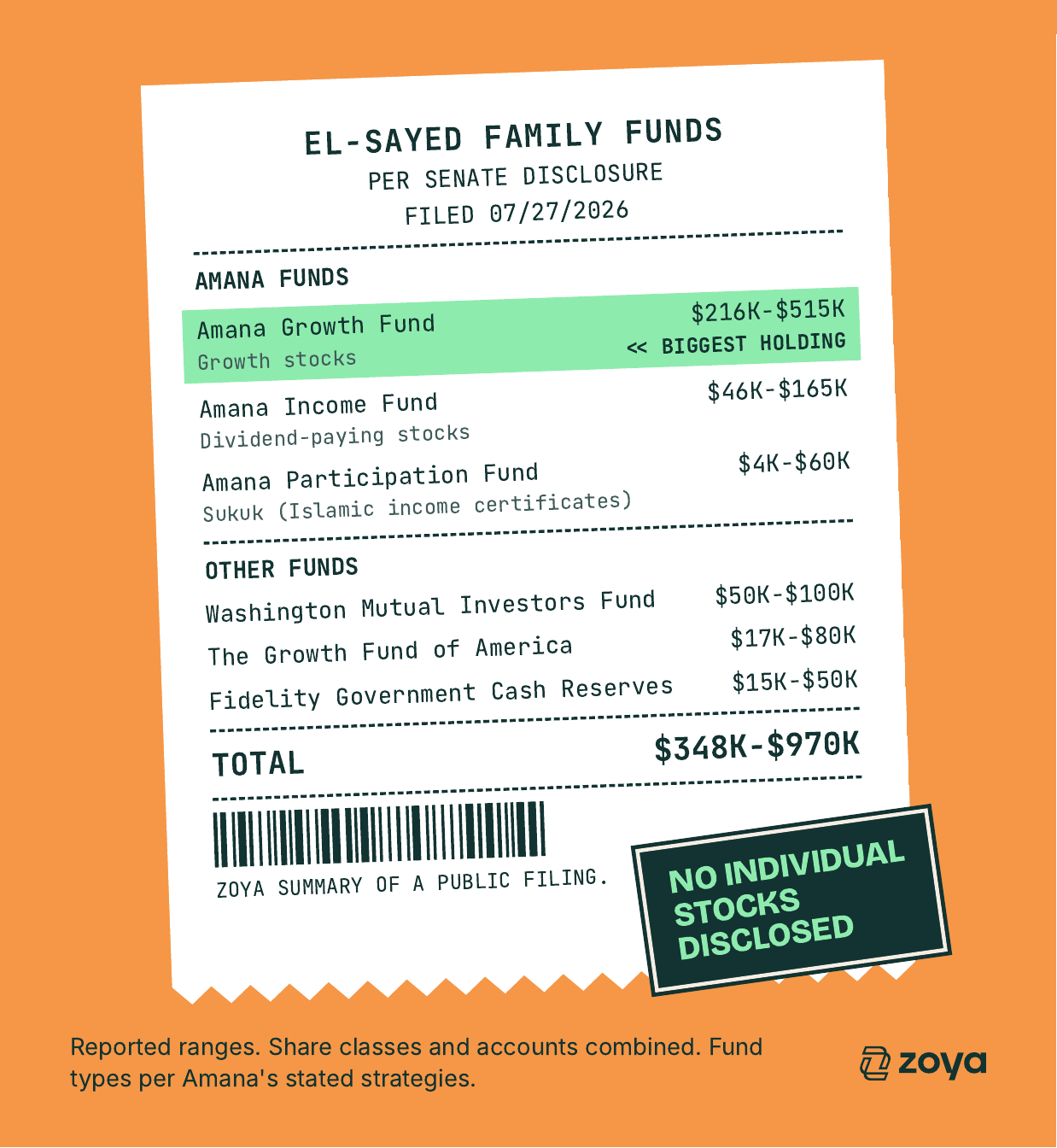
Ranges from the July 27, 2026 Senate disclosure, with share classes and accounts combined.
| Fund | What it holds | Reported value | Whose accounts |
|---|---|---|---|
| Amana Growth Fund | Large growth companies | $216,000 to $515,000 | His and his wife's |
| Amana Income Fund | Large dividend-paying companies | $46,000 to $165,000 | His and his wife's |
| Amana Participation Fund | Sukuk | $4,000 to $60,000 | His and his wife's |
| Washington Mutual Investors Fund | Large US companies | $50,000 to $100,000 | A child's 529 plan |
| The Growth Fund of America | Growth companies | $17,000 to $80,000 | A child's 529 plans |
| Fidelity Government Cash Reserves | Government money market fund | $15,000 to $50,000 | His wife's 401(a) |
| Total | $348,000 to $970,000 |
Taking the midpoint of each range, Amana accounts for about $503,000 of $659,000 in funds, or 76%. The filer also claimed an exemption for some assets, so the disclosure is a partial picture.
What the Amana Growth, Income and Participation funds hold
Most of the disclosed Amana investments are in the lower-cost Institutional shares (AMIGX, AMINX and AMIPX). His wife's 401(a) holds AMAGX, the Growth Fund's Investor class, which owns the same portfolio (AMAGX vs AMIGX explains the difference).
Amana Growth Fund
The Growth Fund holds about 30 large US and foreign companies that Saturna expects to grow their sales and earnings. Technology made up 53.8% of the fund on September 30, 2026, followed by industrials and health care. AMIGX costs 0.61% a year.
Amana Income Fund
The Income Fund aims for current income and preservation of capital, buying mainly large companies that pay dividends. On September 30, 2026, it was 29.8% technology, 27.3% industrials and 19.1% health care. AMINX costs 0.75% a year.
Amana Participation Fund
The Participation Fund holds sukuk (Islamic investment certificates) instead of stocks. Sukuk holders typically have beneficial ownership in an underlying asset or project, such as property or a lease, and receive a share of what it earns, though structures vary (how sukuk work). The fund aims to preserve capital and move less than stocks.
Most of its sukuk come from issuers in Saudi Arabia and the United Arab Emirates, often through vehicles registered in the Cayman Islands:
- Governments: Saudi Arabia, Oman, Indonesia, Bahrain and Sharjah
- State-linked companies: Saudi Aramco, Saudi Electricity and DP World
- Banks: Al Rajhi, Banque Saudi Fransi and Dubai Islamic Bank
- Property and food companies: Emaar, Aldar and Almarai
Saturna counted about 40% of the fund in financial companies and 14% in governments on September 30, 2026. AMIPX costs 0.57% a year.
How Amana's Shariah certification works
Saturna screens every Amana holding under its own Shariah criteria, which exclude businesses such as alcohol, gambling, pork and conventional lending, along with heavily indebted companies. Amanie Advisors, an independent Shariah advisory firm, certifies each fund every quarter. Its most recent letters cover July to September 2026 for Growth, Income and Participation.
Certification and purification are separate steps. Companies in a screened stock fund can still earn a small share of income from impermissible sources. Saturna publishes yearly per-share dividend purification factors for its equity funds, including Amana Growth and Income, in its purification calculator; investors make the purification payments themselves. The Participation Fund has no factor, because Saturna treats its sukuk income as halal once a third party has approved each holding. Our stock purification guide explains how the calculation works.
The other funds in the filing
Washington Mutual Investors Fund and The Growth Fund of America sit in two 529 college savings plans that the filing lists under a dependent child. Fidelity Government Cash Reserves, a government money market fund, sits beside Amana Growth in his wife's University of Michigan 401(a) retirement plan. All three are conventional funds.
Which companies the El-Sayeds' Amana funds invest in
A mutual fund spreads its money across many companies, so the family's Amana money carries exposure to every stock in the two Amana stock funds. The filing lists funds, so the table below is an estimate: each fund's reported range from the July 27 filing, multiplied by each company's share of that fund's holdings on September 30, 2026, with Growth and Income added together. Fund holdings change over time, so treat it as a sketch of exposure through the funds.
Estimated exposure through Amana Growth and Amana Income. Rounded to the nearest $100.
| # | Company | Ticker | Estimated exposure | Midpoint | Through |
|---|---|---|---|---|---|
| 1 | TSMC (Taiwan Semiconductor) | TSM | $21,300 to $56,600 | $38,900 | Growth and Income |
| 2 | Apple | AAPL | $17,700 to $42,200 | $29,900 | Growth |
| 3 | Microsoft | MSFT | $15,700 to $41,700 | $28,700 | Growth and Income |
| 4 | Nvidia | NVDA | $15,600 to $37,200 | $26,400 | Growth |
| 5 | Broadcom | AVGO | $14,700 to $37,600 | $26,100 | Growth and Income |
| 6 | Eli Lilly | LLY | $13,700 to $38,100 | $25,900 | Growth and Income |
| 7 | Alphabet | GOOGL | $14,200 to $33,800 | $24,000 | Growth |
| 8 | ASML | ASML | $14,000 to $33,400 | $23,700 | Growth |
| 9 | Advanced Micro Devices | AMD | $9,600 to $22,800 | $16,200 | Growth |
| 10 | Johnson Controls | JCI | $7,800 to $20,700 | $14,300 | Growth and Income |
These 10 companies make up about 54% of the estimated exposure through the two Amana stock funds. TSMC tops the list because it is a large holding in both.
How the El-Sayed IRAs are invested
An IRA (individual retirement account) is a personal retirement account with tax benefits, and a SEP-IRA is the version for self-employed people. The only investments listed in the three IRAs are Amana funds.
Fund mix estimated from the midpoint of each reported range.
| Account | Reported value | Growth | Income | Participation |
|---|---|---|---|---|
| His SEP-IRA | $66,000 to $165,000 | 65% | 28% | 7% |
| His IRA | $66,000 to $165,000 | 65% | 28% | 7% |
| His wife's IRA | $116,000 to $315,000 | 81% | 15% | 4% |
| Combined | $248,000 to $645,000 | 73% | 22% | 5% |
His wife's University of Michigan 401(a), a fourth retirement account worth $30,000 to $100,000, sits outside the projection below.
What the IRAs could be worth at 65
Born on October 31, 1984, El-Sayed turns 65 in 2049, 23 years from now. As a hypothetical illustration of compounding, here is what the IRAs' combined midpoint of about $446,500 would reach at three steady annual returns, with no new money or withdrawals, before inflation and taxes.
Hypothetical. Ranges apply each return to the low and high reported balances.
| Annual return | Value at 65, from the midpoint | Range |
|---|---|---|
| 4% | $1.10 million | $611,000 to $1.59 million |
| 6% | $1.71 million | $947,000 to $2.46 million |
| 8% | $2.62 million | $1.46 million to $3.79 million |
By the rule of 72, money doubles roughly every 12 years at 6% and every 9 at 8%.
Saturna reports 10-year after-fee returns to September 30, 2026, of 17.45% a year for AMIGX, 12.03% for AMINX and 2.10% for AMIPX. Those are the funds' returns, not the El-Sayed accounts', and past performance does not guarantee future results.
Abdul El-Sayed's real estate, businesses and debts
Beyond the funds, the filing lists property, businesses, bank accounts and debts, each as a value range.
- Real estate: three rental properties worth $450,000 to $1 million combined. A condo in Ann Arbor, Michigan, is held jointly through a family trust ($250,000 to $500,000), and his wife owns a condo in Bangalore, India, and a house in Dubai ($100,000 to $250,000 each).
- Businesses: $66,000 to $165,000 across his media company Incision Media, his consulting firm AME Higher and his wife's psychiatry practice. He also reports a $10,000 stake in a holding company that owns IT services firms.
- Bank accounts: four, worth $18,000 to $95,000 combined.
- Debts: $100,000 to $200,000 in total: joint home financing taken out in 2008 and his wife's balance with a Dubai property developer, each $50,000 to $100,000.
Add up every valued asset in the filing, including the fund accounts, 529 plans and bank accounts, then subtract the reported debts, and the net value of the reported, valued holdings is about $680,000 to $2.1 million. Disclosures use value ranges and exempt some assets, such as a primary home, so treat that figure as a rough sketch.
What stands out in the El-Sayed portfolio
A few features set this portfolio apart. This is a reading of one public filing for education, not investment advice.
- Amana Growth carries most of the weight. At range midpoints, Amana Growth is about 73% of the family's Amana money, so the technology tilt of that one fund shapes much of the family's stock exposure.
- The sukuk slice is small. The Participation Fund holds $4,000 to $60,000, about 6% of the Amana money at the midpoint, and 5% of the combined IRAs.
- The IRAs and the other accounts hold different kinds of funds. All three IRAs hold only Amana. The 529 plans hold two American Funds stock funds, and his wife's 401(a) pairs Amana Growth with a government money market fund.
- Funds rather than individual stocks. The filing lists no individual stocks. Exposure to 51 companies and dozens of sukuk comes through three funds, with Saturna picking the holdings and running the Shariah screen.
How to check your own portfolio for Shariah compliance
Curious what's in your own funds? Search them on Zoya or connect your brokerage to check the holdings. Zoya screens individual stocks, ETFs and US mutual funds holding by holding, including the index funds in a typical 401(k) plan and conventional funds like the ones in the 529 plans above.
Frequently asked questions
Can you hold halal funds in an IRA?
Yes. An IRA at a brokerage can usually hold any mutual fund or ETF the broker offers, including Amana funds and halal ETFs. El-Sayed's three IRAs at Schwab hold only Amana funds. Saturna also waives the $100,000 Institutional minimum for IRAs where Saturna Trust Company is the trustee.
Do Shariah-certified funds need purification?
Stock funds often do. Certification means the fund's holdings pass a Shariah screen, but those companies can still earn a small share of impermissible income. Saturna publishes a yearly per-share dividend purification factor for each Amana equity fund, and investors make the payments themselves. For the year to May 31, 2026, the factor was about $0.0057 per share for AMIGX and $0.0079 for AMINX. The Participation Fund has none, since Saturna treats its sukuk income as halal. Our stock purification guide walks through the steps.